Correcting Breathing Patterns to Rebuild Trunk Control in Movement Recovery

In physiotherapy education, movement recovery is often described in terms of joints, muscles, and exercise dosage. Yet one of the earliest and most influential systems involved in every task is the breath. Correcting breathing patterns can restore trunk control and reduce compensatory tension during reaching, lifting, walking, and other movement tasks. When breathing is efficient, the trunk can respond with appropriate stiffness and mobility at the right moment, allowing the limbs to move with less unnecessary effort.
Breathing is not simply a way to supply oxygen. It coordinates pressure within the abdomen and chest, influences the position of the ribcage, and helps the deep trunk muscles prepare for movement. In physiotherapy, breathing is treated as a foundation for motor control: a skill that can be observed, practiced, and refined alongside strength, balance, and coordination.
Why breathing affects trunk control
The trunk is a pressurized cylinder made up of the diaphragm above, the pelvic floor below, and layers of abdominal and back muscles around the sides. During inhalation, the diaphragm moves downward and the ribs expand. During exhalation, the diaphragm relaxes and the abdominal wall can gently engage. This changing pressure helps stabilize the spine without requiring every muscle to remain tightly braced.
When breathing is shallow, rapid, or led mainly by the neck and shoulders, the pressure system becomes less efficient. The neck muscles may work harder than necessary, the ribcage may stay lifted, and the abdomen may not contribute evenly. As a result, a person may brace through the whole body to create stability, or may lose stability when a task demands coordinated movement. Both patterns can increase tension during ordinary activities.
Physiotherapy assessment therefore looks at more than the depth of a breath. It considers the rhythm, the direction of expansion, the relationship between the ribs and pelvis, and what happens to breathing when a person stands, reaches, or lifts. The goal is not to force a perfect pattern, but to help the body find a flexible and responsive one.
Signs of a compensatory breathing pattern
Some people breathe primarily into the upper chest, especially during stress or concentration. Others hold the breath before a movement, grip the abdomen, or lift the shoulders with each inhale. These strategies are not automatically harmful, but they can become overused and reduce the trunk’s ability to adjust.
Common signs include:
- Neck dominance: visible movement of the neck and shoulders with each breath, often accompanied by a sense of tightness around the jaw or throat.
- Breath holding: pausing during effort, which may create a sudden rise in pressure instead of a gradual, controlled response.
- Restricted rib movement: limited side or back expansion, making the breath feel shallow or stuck.
- Over-bracing: constant tension in the abdominal wall, even when the task does not require strong effort.
- Delayed recovery: difficulty returning to a relaxed breathing rhythm after exercise or a stressful moment.
These patterns may appear alongside pain, fatigue, anxiety, or poor postural habits, but breathing should be assessed within the whole movement context rather than treated as the only cause of symptoms.
Breathing pattern exercises for movement recovery and stress relief
Breathing practice is most useful when it is connected to real movement. The following progression can be adapted by a physiotherapist to suit different abilities and goals.
1. Observe the starting pattern
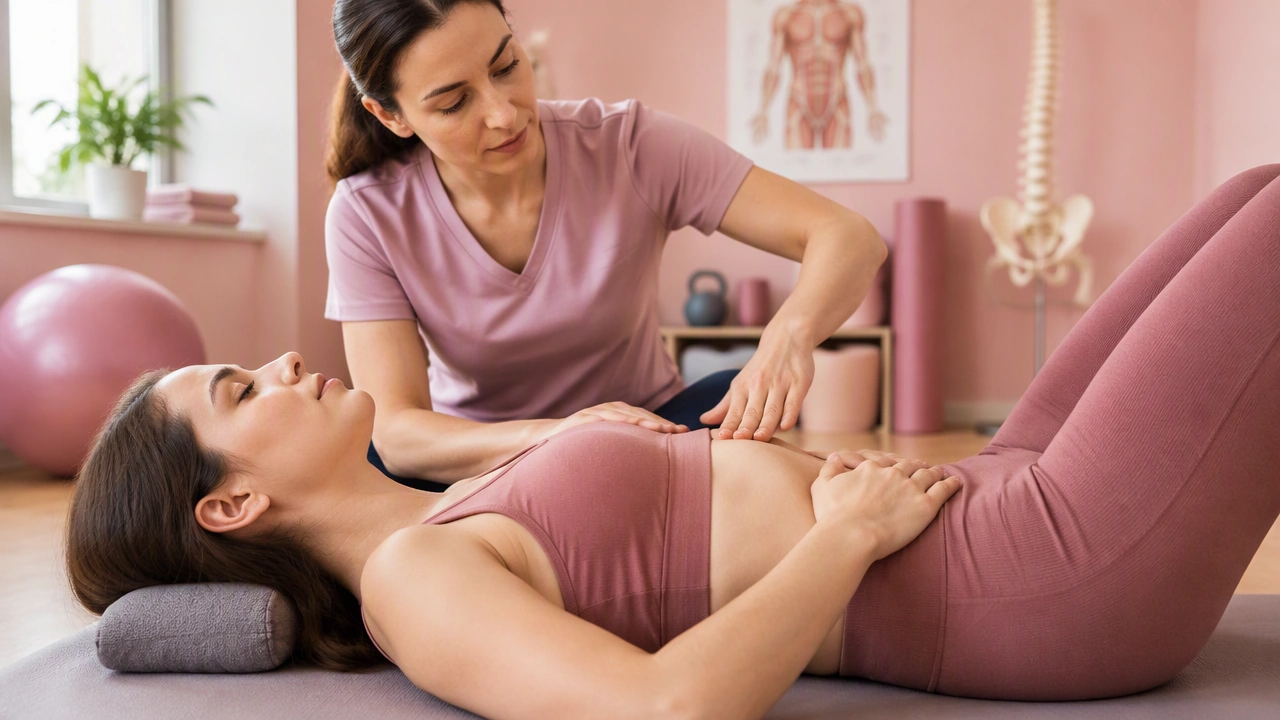
Sit or lie comfortably with one hand on the lower ribs and the other on the abdomen. Allow the breath to continue without changing it at first. Notice where movement is felt, whether the breath is even from side to side, and whether the shoulders lift early. This observation helps establish a baseline and reduces the urge to perform a forced, exaggerated breath.
2. Restore lower rib expansion
Allow a slow inhale through the nose, directing the breath toward the sides and back of the lower ribs. Exhale gently, letting the ribs soften without collapsing the chest. The movement should feel broad rather than strained. A quiet, unhurried rhythm is usually more effective than taking very large breaths.
3. Coordinate breath with gentle activation
During a light exhale, gently draw the lower abdomen inward while keeping the ribs relaxed. Maintain this light tension as the breath returns. This teaches the trunk to create support without rigid bracing. The effort should remain moderate enough that the face, neck, and throat stay relaxed.
4. Link breathing to functional tasks
Apply the same principle to simple movements. Inhale to prepare, then exhale as the movement begins when reaching, standing, or shifting weight. The timing does not need to be identical for every exercise, but the breath should support the task rather than interrupt it. For example, a person practicing a sit-to-stand can exhale during the effort phase and inhale while returning to a stable position.
5. Progress to balance and load
Once the pattern feels comfortable, add light challenges such as carrying an object, stepping over an obstacle, or reaching overhead. These tasks reveal whether breathing remains adaptive under demand. If tension returns, reduce the complexity and rebuild the sequence before progressing again.
How physiotherapy supports lasting change
Breathing retraining works best when it is embedded in a broader movement plan. A physiotherapist may combine breath work with trunk coordination, hip and shoulder mobility, aerobic conditioning, and task-specific practice. This approach recognizes that a person does not breathe in isolation: breathing interacts with posture, confidence, pain experience, and the demands of daily life.
Education also matters. Understanding why the breath changes during effort can reduce fear and unnecessary guarding. When a person learns to notice early tension, they can make small adjustments before the pattern becomes rigid. Over time, these adjustments can make movement feel smoother and less effortful.
A calm foundation for movement
Rebuilding movement is not only about producing more force. It is also about organizing force efficiently. Correcting breathing patterns gives the trunk a reliable way to stabilize, release, and adapt during changing tasks. Through patient practice, breathing pattern exercises for movement recovery and stress relief can support better trunk control, reduce compensatory tension, and create a calmer starting point for the next stage of rehabilitation.